It is a warm and sun-kissed day in Turin when the artist Matteo Roetto welcomes me into his homeatelier.
As soon as I laid foot inside, I found myself surrounded by a mystic atmosphere: I had the perception of travelling to an imaginary dimension. White high walls of the artist’s apartment; sun reflecting wide windows that let the bright sunbeam turn the hanging art pieces into gold. Rays of sunlight complete the spectrum of colour of the room.
Matteo’s workspace can generate a bizarre feeling in the guest’s soul: king and queen of the atmosphere are stranding and attraction towards the abstract and figurative canvas.
The artist from Pinerolo welcomes me to a round table and before he settles with me, he glances at the tools he needs to perfect his pieces. Matteo starts narrating about his life, recalling his own experiences as if he was an external narrator: his story is an intricate string of extraordinary episodes, revealing visions and intricate situations. The artist’s eyes seem to tend beyond a point I can not define; his singularity does not want to be grasped. Matteo looks at the developments of his roots from beyond the leafy branch of his core being; he slightly tilts his neck and he likes to change perspective to see everything that has happened in his life in a new light. I find myself deep
in this artist’s self-investigating process and I surrender to the simplicity of his story. I’m fascinated by imagining the nature of his stories, with no demand for grasping the meaning of “and foundering is sweet in such a sea”. Now, admiring again the pieces hung on the walls, I resemble in them the extension of the artist’s lifestream: a mad quest to reach and conquer expressive freedom. During the stream of our conversation, I appreciate all those literal, musical and artistic references that Matteo quotes: Battiato, Schopenhauer, and Picasso, all speaking the same language.
Ideally allied artists in a utopian tower of Babel.
The artist is genuinely characterized by a sense of “deep feeling”. It is all about personalities able to express, through artistic visions, the variety of trajectories that the soul describes. Like a demiurge, Matteo always experiments different artistic paths, bringing his production through figurative paintings, celestial landscapes, raw and violent installations. Complex and contradictory sceneries rise, but thanks to the artist’s tough personal experiences, he can command them. He knows how to discern his possibilities, by saying “que oui et que non” to the variety of choices that life offers us.
Matteo is “lost in a redemption labyrinth” but unlike Borges’ Asterion, he’s not defeated. The artist resurfaces, and he is aware of his inability to translate the depth of the subconscious; nevertheless, he does not surrender to evoke that magic observed during his explorations, in his art.
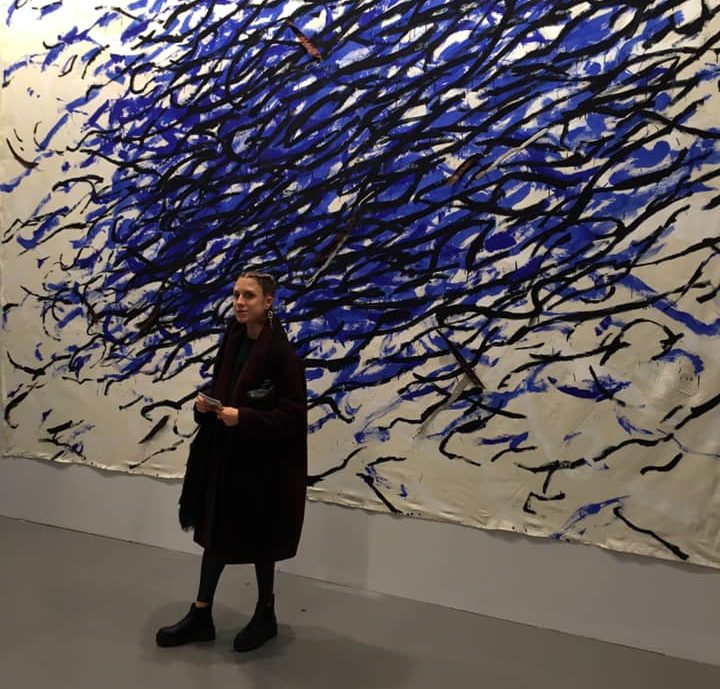
His long-lasting reference towards celestial experiences is emphasized by the use of Prussian blue, Matteo’s favourite. With this colour, the artist prompt to “another” world. He invites us to broaden our sight to an alternative version of reality, where matter opens new and astonishing perspectives.
Today, Matteo is not scared of the “empty spaces” of the mind, anymore; he knows when it’s necessary to open his eyes again, when to turn his back on fantasies and dreams driven by the artistic world, and when it’s time to put himself into his daily office life.
It is hard to accept and forgive our humanity. Matteo’s art pieces suggest a rough path, where selfawareness and derangement intertwine.
We are fragile and irrational, but we always preserve art, in stillness and through the storm; anyhow and anywhen.
Thanks Matteo.
(translated by Giorgia Zanfardin)
 COMPOSTA D'ARTISTA